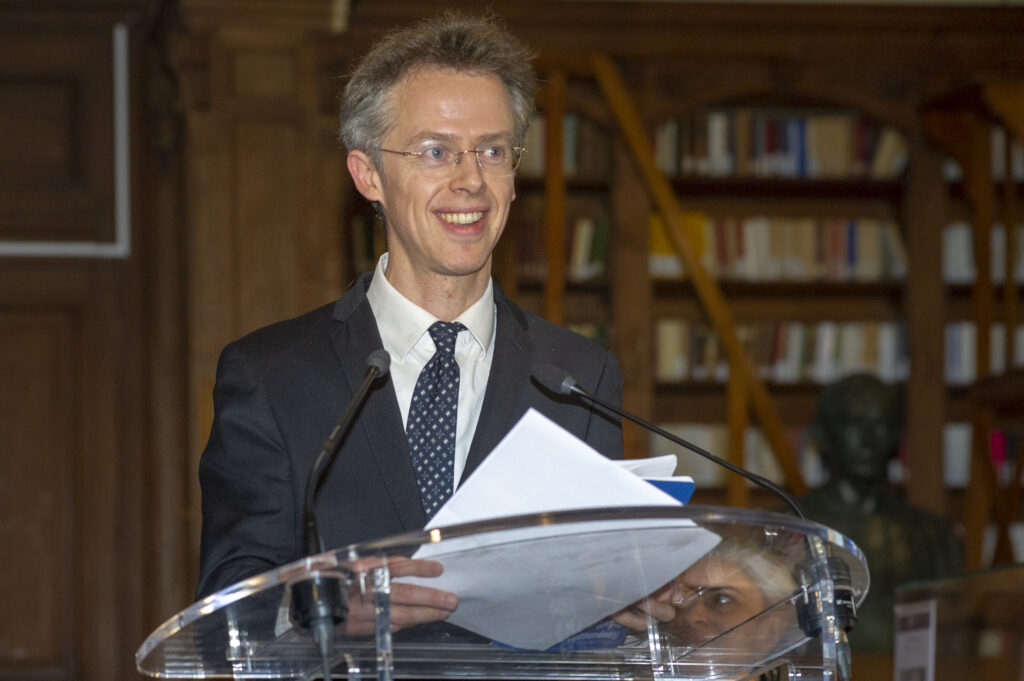
Frédéric Gloriant

Research Topics :

Europe of defense / Cold War / Nuclear Deterrence / France – United Kingdom relations / France – Germany relations

Career

– Lecturer in contemporary history
– Director of the Centre interdisciplinaire sur les enjeux stratégiques (CIENS) at ENS
– Member of the IHMC (Institute of Modern and Contemporary History)
– Thesis defended at Université Paris III, under the supervision of Frédéric Bozo: Le grand schisme. France, Great Britain and Euro-Atlantic issues, 1957-1963
Research

His research focuses on three main questions.
First of all, he will pursue a reflection on the military nuclear fact in Europe, already studied from a Franco-British and Franco-German perspective, by examining the hypothesis of the emergence of a specific relationship between Europeans and nuclear weapons, over and above the deep divisions that have divided them from one another (between nuclear-armed and non-nuclear-armed countries or countries with a neutral tradition; between pro- and anti-nuclear weapons; between “Gaullists” and “Atlanticists”).
His research will also shed light on the role of directorial practices in politico-strategic decision-making, which persist stubbornly within multilateral organizations.
Finally, he is pursuing a project to examine the way in which France has been part of the “global nuclear order” since 1945, studying in particular its contrasting relationship with the non-proliferation regime formalized by the NPT (Non-Proliferation Treaty) in 1968.

Books

Le Schisme franco-britannique : de Suez au veto de 1963, Presses Universitaires de Rennes, 2023. https://books.openedition.org/pur/190621

France, Germany and Nuclear Deterrence. Quarrels and Convergences during the Cold War and Beyond, Berghahn Books, 2022 (collective work co-edited with Nicolas Badalassi).

Selected articles and book chapters

“De Gaulle et Monnet face aux dilemmes nucléaires transatlantiques (1956-1965)”, in Éric Roussel and Laurent Warlouzet (eds.), Jean Monnet et Charles de Gaulle : destins croisés, oppositions et héritages (Rennes, Presses universitaires de Rennes, 2024), pp. 117-139.

“Ukrainian and Russian nuclear trajectories since the end of the Cold War: an attempt at periodization (1986-2023)”, International Relations, 2024, 197(1), 93 – 110.

“To Adapt to the Cold War Bipolar Order? Or to Challenge It? Macmillan and de Gaulle’s Rift in the Face of the Second Berlin Crisis”, Cold War History, vol. 18, no. 4 (2018), pp. 465-83

“Londres et la proposition gaullienne de ‘directoire nucléaire tripartite’ de septembre 1958 : réception, conséquences, symbole”, in Jurgensen, Céline and Mongin, Dominique (eds.), Résistance et Dissuasion – Des origines du programme nucléaire français à nos jours, Paris, Odile Jacob, 2018, pp. 235-258

CIENS team

Frédéric Gloriant

Director – PhD History
Europe of defense / Nuclear Deterrence / France

Stéphanie Braquehais

Project & Comms Manager

Eve Benhamou

PhD History
Middle-East – Nuclear Defense

Marie-Gabrielle Bertran

PhD Geography
Cybersecurity – Russia

Pierre-Louis Six

PhD History
Russian foreign policy – Nuclear issues – Uranium

Louise Matz

PhD History
Nuclear – Deterrence – Air Force

Elsa Novelli

PhD Philosophy
Cognitive Warfare – Attention Economy – AI

Julien Dubois

PhD Student
Ukraine – Nuclear – Non-Proliferation

Our associate researchers

Yannick Pincé

PhD History
Nuclear issues – Deterrence – Domestic policy

Johanna Möhring

PhD Political Science
AI – Military Command

Maïlys Mangin

PhD Political Science
Iran – Nuclear Defense – AI – Information Warfare

Our associate experts

Laurent Prosperi

PhD in IT

Paul Zajac

Partner Relations Coordinator. CEA Associate Expert

Dominique Mongin

History Lecturer, CEA

Guillaume Schlumberger

Associate researcher at the Fondation pour la Recherche Stratégique

Mélanie Rosselet

Diplomat

Our speakers

Isabelle Facon

Deputy Director at the Strategic Research Foundation

Corentin Brustlein

Political Delegate

Lise Dubois

PhD Student

Founder

Nicolas Roche

Ambassador, CIENS Honorary Chairman